Inside the body
You are electric. And so is everything alive.
Not a metaphor. Not a mystical vibration. A measurable biological reality — your heart, brain, nerves and muscles are producing real electrical activity right now. Here's what the science actually says, and what it doesn't.
There is a current running through you right now. Your heart is producing electrical activity. Your brain is alive with oscillating patterns. Your nerves are carrying impulses through intricate pathways. Your muscles are firing electrical signals with every movement. Before science had names for any of it — action potentials, ECG, EEG, EMG — the body was already running its silent electrical symphony.
We usually picture the body in physical terms: bones, blood, organs, muscle, skin. But beneath that visible architecture is another layer of biology, governed partly by electrical potentials created by ions moving across cell membranes. Sodium, potassium, calcium and chloride sit at different concentrations inside and outside our cells. When specialized channels open and close, that movement changes the voltage across the membrane — and in excitable tissue like nerve, muscle and heart, those voltage changes become signals.
So when we say the body is bioelectric, we're not saying a human being is a battery. We're saying something more precise: living tissue uses electrical phenomena as part of the machinery of life.
Part one
Your heart writes in electricity
Place two fingers against your wrist and wait. There it is — beat, beat, beat. What you feel is mechanical, the movement of blood as the heart contracts. But that contraction doesn't begin randomly. Electrical activation coordinates it, and the familiar electrocardiogram (ECG) detects those differences in electrical potential at the surface of the body.
Researchers have gone further still. In a 2021 Scientific Reports study, Yang and colleagues recorded magnetocardiographic signals from a healthy human alongside a simultaneous ECG, mapping the magnetic and current distributions tied to cardiac activity. Your heart doesn't merely beat — its activity carries an electrical signature that instruments can record. Not metaphorical rhythm. Measurable rhythm.

Part two
Your brain is not silent
Close your eyes and picture your childhood home, or listen to a piece of music in your head. Nothing appears to move outside your skull — yet inside it, enormous populations of neurons are running rapidly changing electrical activity, some of it measurable with electroencephalography (EEG).
That activity isn't uniform. It shows up as oscillations across different frequency bands — terms like alpha, beta and gamma aren't wellness-poster language, they're the names researchers use for ranges of oscillatory neural activity. A 2021 human EEG study by Strube, Rose, Fazeli and Büchel recorded volunteers on a visual task and found measurable shifts in alpha-to-beta and gamma-band activity tied to different stages of information processing. A 2022 Scientific Reports study even demonstrated scalp-attached magnetoencephalography (MEG) sensitive enough to detect the tiny magnetic fields tied to that neural current.
Delta
Theta
Alpha
Beta
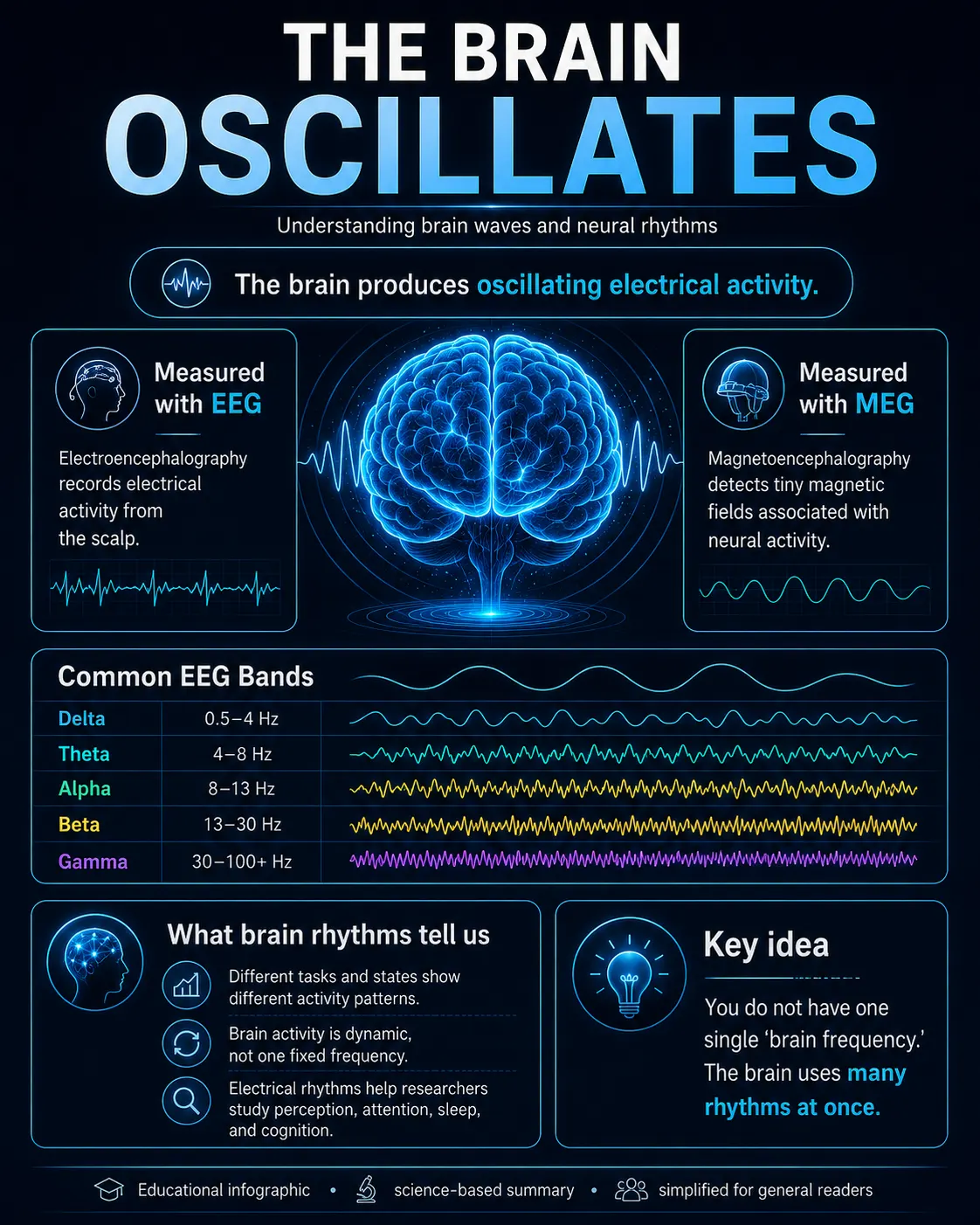
Your thoughts aren't radio transmissions escaping into the universe. But thinking is accompanied by genuine, measurable physical activity — electrical, chemical, dynamic, rhythmic. The wonder gets bigger, not smaller, once you stop having to exaggerate it.
Part three
Your nerves carry electrical impulses
Touch something cold. Pull your hand back from something hot. Move a finger. Behind these effortless experiences is an extraordinary communication network — your nervous system. Neurons are electrically excitable cells, and one of their fundamental signaling mechanisms is the action potential: a rapid change in membrane voltage that propagates along an axon.
This isn't only observed in lab animals. In a landmark study published in Brain, Brink and Mackel used microneurography to record action potentials directly from 57 identified human median-nerve sensory fibers, measuring properties like action-potential duration and conduction velocity — some impulses traveling at tens of meters per second. Something touches your hand, receptors respond, and electrical events race through living wiring. Information moves.
Part four
Your muscles speak electrically
Raise your hand. Take a step. Smile. Behind every voluntary movement, motor neurons activate muscle fibers, and that electrical activity can be detected with electromyography (EMG) — including its frequency content. Merlo and colleagues recorded surface EMG from human thigh muscles during isometric and explosive contractions, running a time-frequency analysis to relate the signal's frequency characteristics to muscle-fiber conduction.
You see a leg move. The instrument sees changing voltage over time. You see motion. Biology reveals communication.

Part five
So what does "human frequency" actually mean?
This is where science and popular internet claims tend to part ways. Yes, the body contains activity at measurable frequencies. But there is no scientifically established single frequency of an entire human being — no one number that represents "your vibration." The body runs many rhythms at once: a heartbeat rhythm, a breathing rhythm, many oscillatory patterns across neural populations, a spectrum of frequencies in muscle signals, individual neurons firing at changing rates.
An orchestra doesn't become music because every instrument plays the same note. It becomes music because different instruments, pitches, tempos and timings somehow become one living composition. The body is closer to that — not one frequency, a symphony.
Part six
Does the body create an electromagnetic field?
In a strict physical sense, electrical currents produce magnetic fields — and because the heart and nervous system involve electrical currents, extremely weak associated magnetic fields can be measured with sufficiently sensitive equipment. Magnetocardiography detects the field tied to cardiac activity; magnetoencephalography does the same for the brain's neural current. That gives real scientific meaning to the statement that the human body produces measurable electromagnetic activity.
But here's where the wonder needs protecting from exaggeration. These measurements don't establish a glowing spiritual aura around the body. They don't prove that a person carries one universal energetic frequency. And they don't show that anyone's electromagnetic activity attracts money, relationships, luck or outside events. Science gets more powerful, not less, when we refuse to make it say things it hasn't said.
System 01
Heart
ECG-detectable rhythm, plus faint associated magnetic fields measurable by magnetocardiography.
System 02
Brain
EEG oscillations across delta, theta, alpha, beta and gamma bands, plus MEG-detectable neural magnetic activity.
System 03
Nerves
Action potentials — rapid voltage changes propagating along axons, carrying sensory and motor signals.
System 04
Muscles
EMG-detectable electrical activity with its own frequency content, tied to fiber conduction.
Part seven
What science actually allows us to say
Put together, the honest claims are already remarkable: your heart produces measurable electrical activity. Your brain shows electrical oscillations across multiple frequency ranges. Your nerves transmit information through action potentials. Your muscles produce electrical activity that can be recorded and analyzed. And the currents behind cardiac and neural activity generate extraordinarily weak, but detectable, magnetic fields.
Which makes this a scientifically reasonable sentence: the human body is bioelectric. Not because the universe assigned you a mystical vibration. Not because thinking at a certain frequency rearranges reality. But because electricity is woven into the physiology of being alive.

The miracle didn't disappear when we measured it
Before we understood lightning, it was mysterious. Understanding electricity didn't make lightning less magnificent. Before we understood stars, they were lights in the night — learning they were enormous suns burning across unimaginable distances didn't shrink their beauty, it multiplied it. The same is true of the body. You don't need an invisible mystical frequency to make yourself extraordinary. The measurable reality already is.
Billions of neurons in constant electrical and chemical communication. A heart maintaining its own repeating activation. Sensory impulses racing through nerves. Muscle fibers answering neural commands. Countless rhythms rising, falling, synchronizing, separating and beginning again — while you sleep, while you work, while you laugh, while you remember, while you love, while you're completely unaware any of it is happening.
You are not one frequency. You are a living biological system — a network of cells, a civilization of signals, an orchestra of rhythms. Maybe the message isn't "raise your vibration." Maybe it's simpler: understand the life already moving within you.
Scientific references
- Yang, Y., Xu, M., Liang, A., Yin, Y., Ma, X., Gao, Y., et al. (2021). A new wearable multichannel magnetocardiogram system with a SERF atomic magnetometer array. Scientific Reports, 11, 5564.
- Strube, A., Rose, M., Fazeli, S., & Büchel, C. (2021). Alpha-to-beta- and gamma-band activity reflect predictive coding in affective visual processing. Scientific Reports, 11, 23492. DOI: 10.1038/s41598-021-02939-z.
- Brink, E. E., & Mackel, R. G. (1993). Time course of action potentials recorded from single human afferents. Brain, 116(2), 415–432. DOI: 10.1093/brain/116.2.415.
- Merlo, E., Pozzo, M., Antonutto, G., di Prampero, P. E., Merletti, R., & Farina, D. (2005). Time-frequency analysis and estimation of muscle fiber conduction velocity from surface EMG signals during explosive dynamic contractions. Journal of Neuroscience Methods, 142(2), 267–274.
- Kanno, A., Nakasato, N., Otsuka, A., et al. (2022). Scalp attached tangential magnetoencephalography using tunnel magneto-resistive sensors. Scientific Reports, 12.
If your body runs on real signals, what about what you wear against it?
We took this same question and pointed it at eyewear in "You Are Not Your Body" — what the viral graphic gets right, what it doesn't, and why material composition is the part worth paying attention to.