Material science
Tourmaline has been around for centuries. We grind it to a billionth of a metre.
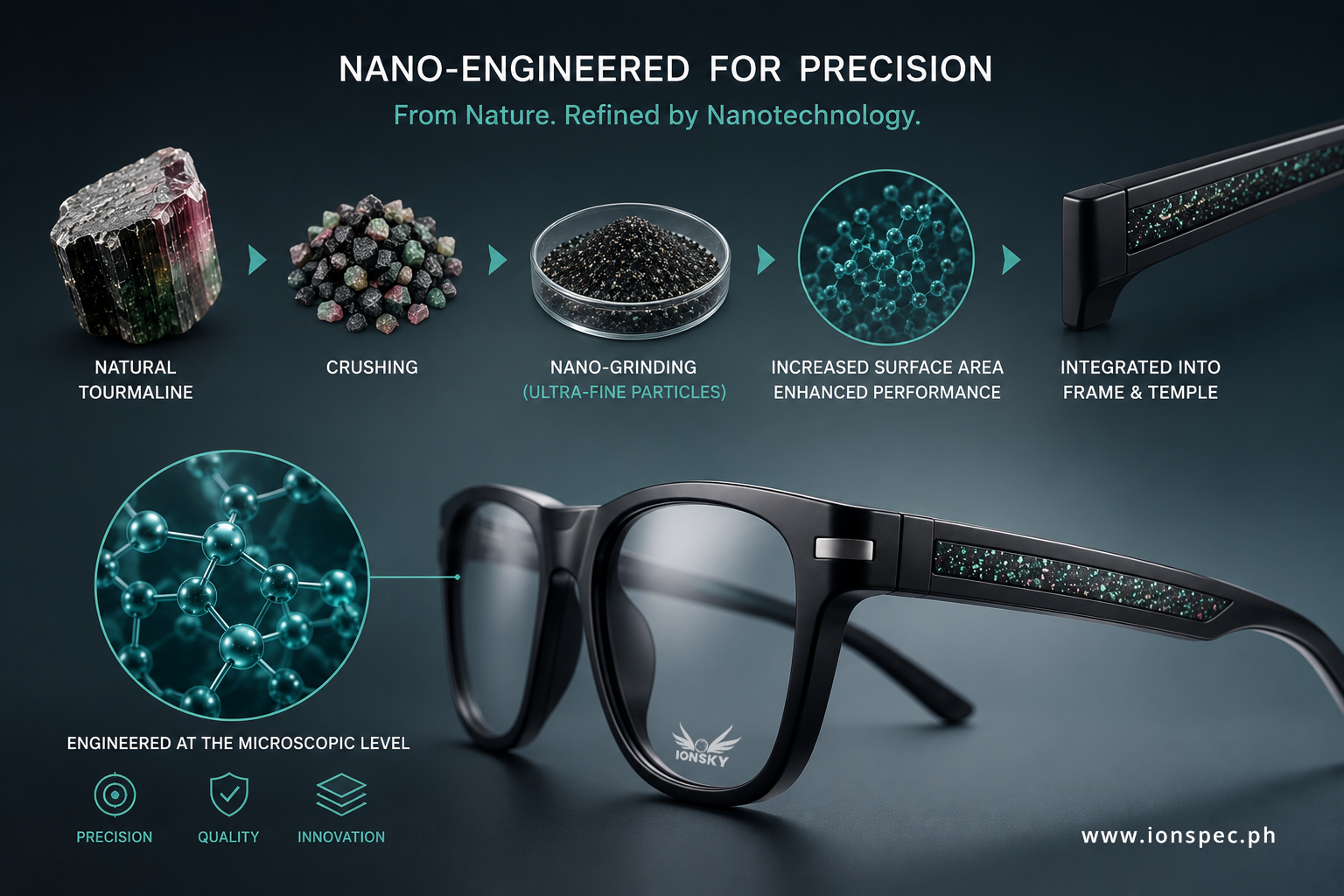
Nano-Engineered Tourmaline Technology is the manufacturing process at the centre of IonSpec Eyewear - a natural mineral milled into ultra-fine particles and built directly into the frame and temple structure. Here is how the material is made, and why the scale is the whole point.
Eyewear used to answer one question: can you see better with it on? Everything else - weight, colour, brand - was styling. But the frame is the part that actually spends the whole day touching you, and material science has quietly turned that structural component into something worth engineering.
That is where IonSpec starts. Not at the lens, but at the raw material the frame is made from.
Part one
The mineral, before anything is done to it
Tourmaline is a naturally occurring crystalline mineral, and it has held scientific attention for a long time for reasons that have nothing to do with jewellery. It is pyroelectric and piezoelectric - it develops an electrical charge in response to changes in temperature and to mechanical pressure - and it emits far-infrared radiation under certain conditions.
Those are properties of the rock itself. They are not added, coated on, or switched on. So the question for a manufacturer is not how to give tourmaline these characteristics. It is how to get more out of the ones it already has.

Part two
What nanotechnology does to it
Nanotechnology is the science of working with materials at extremely small scale. A nanometre is one-billionth of a metre - small enough that engineering decisions can be made with a precision that simply was not available to earlier manufacturing.
At IonSpec, tourmaline goes through a specialised nano-grinding process. Three stages, and none of them are cosmetic.
Step 01 · Source
Natural tourmaline is selected and prepared
Raw mineral is graded and prepared for milling. Consistency at this stage is what makes consistency possible in every frame that follows.
Step 02 · Mill
Nano-grinding into ultra-fine particles
The mineral is milled down to nanoscale. This increases the total surface area of the material dramatically, allowing its natural characteristics to be distributed far more efficiently through the finished frame and temple.
Step 03 · Integrate
Molded into frame and temple
The nano-powder becomes a foundational raw material in production - not a coating, not an insert, not a printed layer. It is molded into the structure itself.
Part three
Why particle size changes the material
This is the part that is easy to skim past, so it is worth slowing down for. One of the founding principles of nanotechnology is that a material behaves differently once its particles get small enough - not slightly differently, but measurably so, because far more of the material is exposed.
Same volume of mineral · different exposed surface
One particleBulk mineral. Most of the material is locked inside, never in contact with anything.
Many particlesDivide it and the volume is unchanged - but every new cut face is fresh exposed surface.
Illustrative. Halving particle size doubles the total surface area of a given volume of material, and at nanoscale that multiplication runs for many orders of magnitude. Surface area is what determines how much of a mineral's natural behaviour is actually available at the surface of the finished product.
When tourmaline is engineered into ultra-fine particles, five things change in the manufacturing outcome:
- 01Surface area increases dramatically
- 02Material distribution becomes more uniform
- 03Structural integration improves
- 04Manufacturing precision is enhanced
- 05Material performance becomes more consistent
Part four
Built into the frame, not onto it
Most eyewear that claims a material advantage delivers it as a surface treatment - a coating, a film, a printed layer. IonSpec incorporates nano-engineered tourmaline directly into the frame and temple materials during production.
The technology becomes part of the eyewear itself - not simply an added layer.
The practical difference is durability. Coatings scratch, oxidise and lose contact with the skin over months of daily wear. A material property does not, because there is no layer to wear through - the composition of the frame is the same at the surface as it is in the middle.
That integration also raises the manufacturing bar. Every stage of production is built around precision, consistency and quality control, because a material blended through the whole structure cannot be corrected afterwards the way a coating can be reapplied. The nano-grinding process is what makes it possible to carry the mineral's natural characteristics into a frame that is still lightweight and comfortable enough to wear all day.
Part five
Where this fits in the wider field
Nanotechnology is not a niche eyewear idea. Researchers are applying the same principles across electronics, aerospace, healthcare and advanced materials - anywhere the behaviour of a material at very small scale can be turned into a better finished product.
IonSpec applies those principles to something you already own and already wear. As material science keeps moving, the pairing of nano-engineering with natural minerals is one of the more interesting directions in everyday product design: nothing exotic added, just an ordinary material understood and processed far more precisely.
Nano-Engineered. Precision Crafted. IonSpec.
Keep reading
- How Ionspec Eyewear Works: The Nanotech Inside the Frame - the three minerals, the published study, and what the research reported.
- Black Tourmaline Stone - the mineral in more detail.
- Nano Technology - how nanoscale engineering is used across other industries.
- Licenses, certificates and journal - MDA registration, ISO 13485:2016 and the full certification list.
Please noteThis page describes materials and manufacturing only. IonSpec Eyewear is a wellness product. It is not intended to diagnose, treat, cure or prevent any disease, and it is not a replacement for a comprehensive eye examination or for prescribed treatment. Individual experiences vary. For any eye concern, please consult a licensed optometrist or ophthalmologist.
See the frames
Nano-infused frames in prescription-ready and plano options, fitted through our Philippine distributor network.
Browse the collection Become a reseller